 Dark Sky Stays
Stargazing
Bortle scale
The Bortle scale rates night-sky darkness from 1 (darkest) to 9 (inner city). Our listings show each place’s Bortle class, based on light-pollution map data.
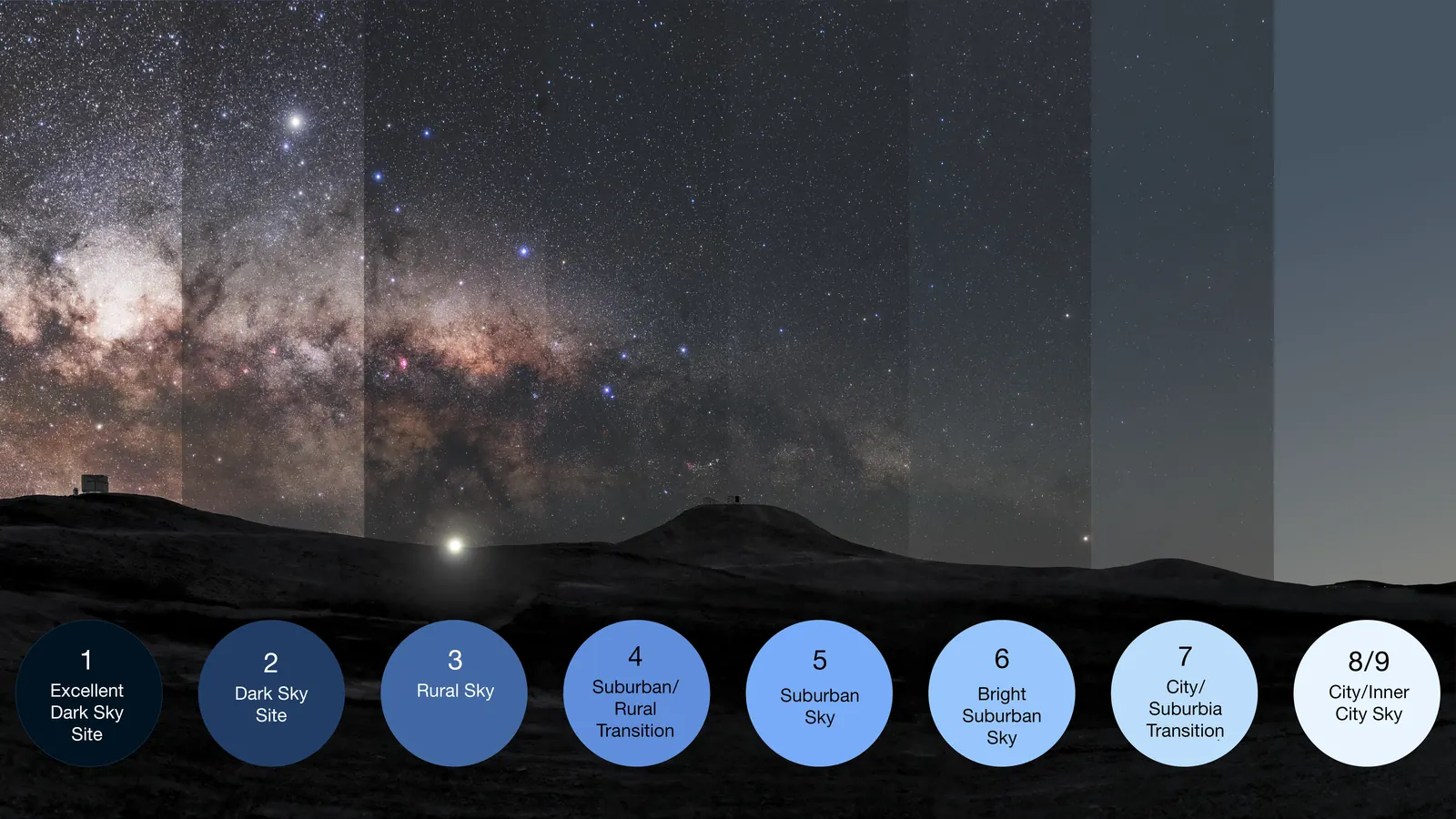
- Bortle 1: Excellent dark-sky site. The Milky Way casts shadows; zodiacal light and airglow visible; no light domes.
- Bortle 2: Typical truly dark site. Milky Way highly structured; faint glow may appear low on the horizon.
- Bortle 3: Rural sky. Some light domes on the horizon; Milky Way still shows structure overhead.
- Bortle 4: Rural/suburban transition. Light domes in several directions; Milky Way visible but lacking detail.
- Bortle 5: Suburban sky. Milky Way faint or washed out near the horizon; clouds lit from below.
- Bortle 6: Bright suburban sky. Milky Way only near the zenith, if at all; sky glows grey-white.
- Bortle 7: Suburban/urban transition. Whole sky greyish; Milky Way invisible; only brighter stars.
- Bortle 8: City sky. Sky glows orange or grey; only the brightest stars and planets.
- Bortle 9: Inner-city sky. Only the Moon, planets and a handful of the brightest stars.
More: Bortle scale (Grokipedia)
Where to go
Get away from town lights: any of our dark-sky stays and campsites makes a good base. Astrotourism WA also maps astrophotography hot spots and stargazing trails around regional WA, and the resources page links light-pollution maps.
What you can see
The southern sky is one of the richest on Earth. Under dark rural WA skies you can see:
- The Milky Way core, high overhead in winter.
- The Large and Small Magellanic Clouds, neighbouring galaxies visible to the naked eye.
- The Emu in the Sky, a dark-nebula constellation in Aboriginal astronomy.
- Meteor showers, planets and satellites all year round.
Tips
- Give your eyes 20–30 minutes to adapt, and use red light only.
- Check the moon phase; new moon weeks are darkest.
- Binoculars are a great first instrument.